
Medical Device Importer Obligations Under MDR Article 13
Updated: Sep 29
A medical device importer carries more obligations, relative to how little it usually knows about the device, than any other economic operator. Regulation (EU) 2017/745 gives it ten paragraphs in Article 13 alone, and most of them are discharged before the first pallet clears customs. For a manufacturer established outside the Union this matters twice over: your importer's failures become your market access problem, and the checks your importer is required to perform are checks on your file.
What a medical device importer actually is under Article 2(33)
Article 2(33) defines an importer as any natural or legal person established within the Union that places a device from a third country on the Union market. Article 2(34) defines a distributor as any person in the supply chain, other than the manufacturer or the importer, that makes a device available up until the point of putting into service. The definitions are mutually exclusive by construction — the distributor definition expressly carves out the importer.
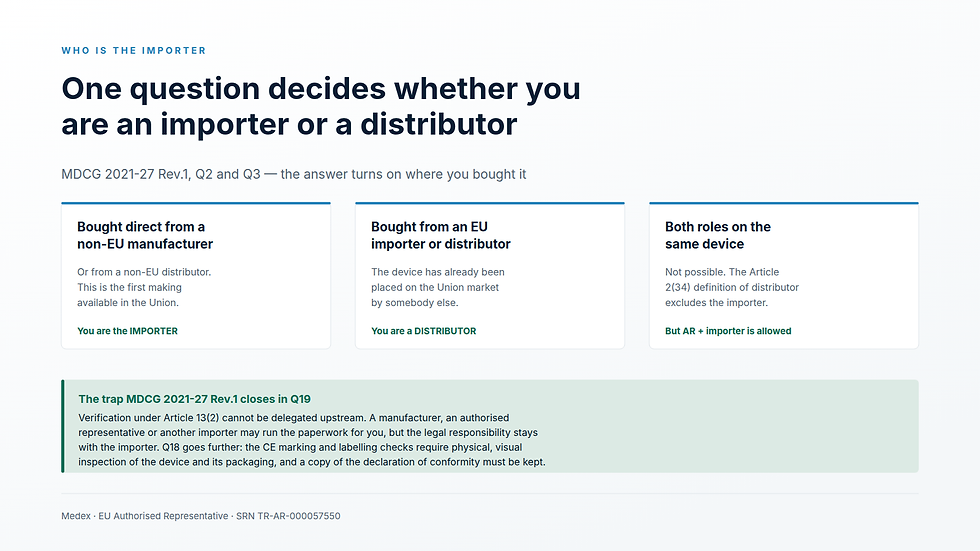
MDCG 2021-27 Rev.1 reduces this to one operational question in Q2 and Q3. If you obtained the device directly from a non-EU manufacturer or a non-EU distributor, you are the importer of those individual devices. If you obtained it from a party already established in the Union, the first making available has already happened and you are a distributor. Q4 adds the detail most people miss: because placing on the market attaches to each individual product rather than to the model, the same model can have several importers in parallel — but only one for any given unit.
Q17 closes the loop. The same legal person cannot be both importer and distributor of the same individual device. Q16 confirms that the same legal person can be both authorised representative and importer, provided it discharges both sets of obligations separately. A company that has quietly been treating itself as a distributor while buying directly from Asia is a medical device importer in law, with no importer registration, no importer marking on the pack, and a gap that surfaces at the first inspection.
The four checks in Article 13(2), and why they cannot be outsourced
Article 13(2) requires the importer to verify four things before placing a device on the market: (a) that the device has been CE marked and that the EU declaration of conformity has been drawn up; (b) that a manufacturer is identified and that an authorised representative in accordance with Article 11 has been designated; (c) that the device is labelled in accordance with the Regulation and accompanied by the required instructions for use; and (d) that, where applicable, a UDI has been assigned in accordance with Article 27.
MDCG 2021-27 Rev.1 Q18 explains how those checks are made, and the answer is more physical than most procedures assume. CE marking and labelling require physical checks — visual inspection of the device and its packaging. The EU declaration of conformity must be requested and a copy kept. The representative's designation may be verified through EUDAMED, through the labelling, or by contacting the manufacturer. Sampling is expressly offered to distributors for certain checks under Article 14(2); it is not offered to importers.
Q19 defeats the most common workaround. Verification cannot be delegated upstream. A manufacturer, an authorised representative or another importer may perform the operational work, but legal responsibility and liability stay with the importer. Where the importer concludes the device is not in conformity it must not place it on the market and must inform the manufacturer and the representative. Where the device presents a serious risk or is falsified, it must additionally inform the competent authority of its own Member State of establishment.
Article 13(3): your details on the pack, without covering the manufacturer's
Article 13(3) requires the importer to indicate its name, registered trade name or registered trade mark, its registered place of business and the address at which it can be contacted, on the device, on its packaging, or in a document accompanying the device. The three carriers are genuine alternatives here. Compare Article 16(3), which imposes a hierarchy: on the device, or where that is impracticable on the packaging, or in an accompanying document.
The second sentence is where files fail. Any additional label must not obscure any information on the label provided by the manufacturer. MDCG 2021-27 Rev.1 Q8 reinforces this and adds that accompanying documentation should reach the smallest saleable package and must follow the device through the supply chain to the end user. Importer details printed only on the shipping carton do not satisfy that.
Q6 and Q7 cover the two situations that arise in practice. The importer is responsible for the marking and may subcontract the task but not the responsibility; the distributor downstream must verify it has been done under Article 14(2)(c). Where a pack already carries another party's importer details, the question is whether that individual device was already placed on the Union market. If it was, you are a distributor and must not add importer details. If it was not, you replace them with your own.
EUDAMED: what the importer files, and what it only verifies
Article 13(4) contains two distinct duties: verify that the device is registered in the electronic system in accordance with Article 29, and add your own details to that registration in accordance with Article 31. A medical device importer never registers a device. Basic UDI-DI and UDI-DI registration is the manufacturer's obligation under Articles 27 and 29, and the representative's verification duty under Article 11(3)(c).
Actor registration is different. Under Article 31, manufacturers, authorised representatives and importers each submit the information in Section 1 of Part A of Annex VI and receive a single registration number. The SRN is issued after validation by the national competent authority — it is not self-service and cannot be obtained on the morning of a shipment. Distributors have no EUDAMED registration obligation at all, though Member States may impose national registration under Article 30(2).
This stopped being optional. Commission Decision (EU) 2025/2371, published in the Official Journal on 27 November 2025, confirmed that the actor registration, UDI and device registration, notified body and certificate, and market surveillance electronic systems are functional. Under Article 123(3) as amended by Regulation (EU) 2024/1860, that publication started a six-month period, and those four modules became mandatory on 28 May 2026. MDCG 2021-27 Rev.1 Q21 adds an active duty few importers have proceduralised: within two weeks of placing a device on the market, verify that the manufacturer or representative has entered the required information, and report back to them where it is missing, incomplete or incorrect.
Where medical device importer files actually fail
Six problems recur. The first is the sticker. An importer label placed over the manufacturer's label, the UDI carrier, the lot number or a symbol breaches Article 13(3) directly. If it changes the information supplied by the manufacturer it can also cross into Article 16(2)(a), which brings Article 16(3) and 16(4) with it — a quality management system certified by a notified body, and 28 days' prior notice to the manufacturer and the competent authority. MDCG 2021-26 Q11 confirms that this notified body certificate is required even for class I devices, which have no notified body in their normal route.
The second is the register. Article 13(6) requires a register of complaints, non-conforming devices, recalls and withdrawals, and requires the importer to give the manufacturer, the representative and distributors whatever they request in order to investigate complaints. Article 13(8) requires complaints and reports from healthcare professionals, patients or users about suspected incidents to be forwarded immediately. The third is retention. Article 13(9) requires the importer to keep a copy of the EU declaration of conformity and any relevant certificate for the period in Article 10(8) — at least ten years after the last device covered by that declaration was placed on the market, fifteen years for implantable devices. The clock runs on the manufacturer's declaration, not on your own shipment dates, so a rolling retention schedule keyed to invoices deletes records too early.
The fourth is traceability: Article 25(2) requires the importer to identify, for the same period, every economic operator it supplied, every one that supplied it, and every health institution or healthcare professional it supplied directly. The fifth is logistics. MDCG 2021-27 Rev.1 Q9 and Q10 state that third-party logistics providers are normally neither importers nor distributors where they only transport or hold devices without legal ownership under a clearly defined agreement — so responsibility for the Article 13(5) storage and transport conditions stays with the importer. The sixth is system and procedure packs: under Q24, an assembler sourcing CE-marked component devices from a third-country manufacturer is the importer of those devices and carries Article 13 in addition to Article 22.
What none of this moves off the manufacturer
Article 11(4) is worth reading next to Article 13. A mandate given to an authorised representative cannot delegate the manufacturer's obligations under Article 10(1), (2), (3), (4), (6), (7), (9), (10), (11) and (12). Device conformity, the technical documentation, the declaration of conformity, the quality management system, post-market surveillance and corrective action stay where they are, whatever the contract says.
The representative's own list in Article 11(3) is a verification and availability list, not a substitute manufacturing file: verify that the declaration and technical documentation have been drawn up, keep a copy available for the Article 10(8) period, comply with Article 31 registration and verify the manufacturer's Article 27 and 29 registrations, answer competent authorities in the official Union language they determine, forward sample requests, cooperate on corrective action, pass on incident reports, and terminate the mandate where the manufacturer acts contrary to its obligations.
The practical consequence for a manufacturer outside the Union is short. A medical device importer cannot repair a defect in your technical file, and an authorised representative cannot repair a defect in your importer's marking or registration. The two sets of duties run in parallel and are inspected separately. We are not a law firm and do not provide legal advice.
Selling directly to end users over the internet raises separate questions under Article 6 of the MDR, covered in our note on distance selling of medical devices.
Sources
Regulation (EU) 2017/745, Articles 2(33), 2(34), 11, 13, 16, 25, 27, 29, 30, 31 and 123(3)
MDCG 2021-27 Rev.1 — Questions and Answers on Articles 13 & 14 of Regulation (EU) 2017/745 and Regulation (EU) 2017/746, December 2023
MDCG 2021-26 — Questions and Answers on repackaging & relabelling activities under Article 16, October 2021
Regulation (EU) 2024/1860 of 13 June 2024 as regards a gradual roll-out of Eudamed, OJEU 9 July 2024
Commission Decision (EU) 2025/2371 of 26 November 2025, OJ L, 2025/2371, 27 November 2025
Who wrote this
Medex is an authorised representative established in Ankara and registered in EUDAMED under SRN TR-AR-000057550. We are not a law firm and do not provide legal advice. Send us your device list and your importer arrangement, and we will respond in writing.


Comments