
EUDAMED Is Now Mandatory: What Non-EU Manufacturers Still Have to File
Updated: Sep 29
EUDAMED is no longer optional. On 27 November 2025 the European Commission published Decision (EU) 2025/2371 in the Official Journal, declaring the first four modules of the database functional. Under the transitional provisions of Regulation (EU) 2024/1860 that publication started a six-month clock, and on 28 May 2026 those modules became mandatory to use.
For a manufacturer established outside the European Union, this changes the order in which things have to be done — and it puts the authorised representative on the critical path.
The four modules now in force
Actor registration. UDI/Devices registration. Notified Bodies and Certificates. Market Surveillance.
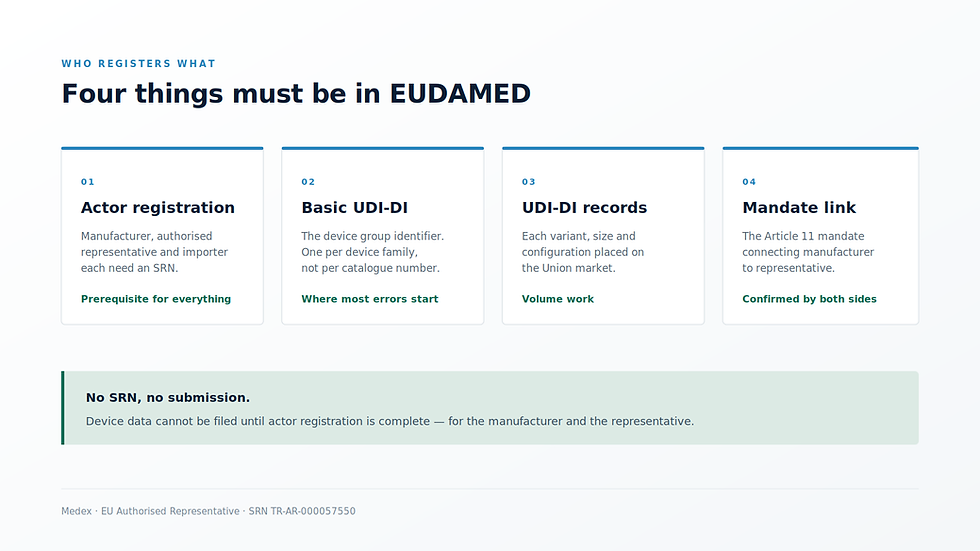
The first of these is the one that blocks everything else. An actor registration produces a Single Registration Number, and without an SRN no device data can be submitted at all. Both the manufacturer and the authorised representative need one, and the mandate linking them has to be confirmed by both sides in the system.
The deadlines still ahead
28 May 2026 was the start of mandatory use, not the end of the transition. Two further dates run from the same publication of 27 November 2025.
For devices, Article 123(3)(e) of the MDR, as amended by Regulation (EU) 2024/1860, provides: "no later than 12 months from the date of publication of the notice referred to in Article 34(3) in respect of the electronic system referred to in Article 33(2), points (a) and (b), manufacturers shall ensure that the information to be entered in Eudamed in accordance with Article 29 is entered in that electronic system". The Commission's transition timeline gives that date as 28 November 2026. It covers devices already on the market that continue to be placed on the market, including legacy devices, unless the MDR version of the same device is already registered.
For certificates, point (ea) of the same paragraph provides: "no later than 18 months from the date of publication of the notice referred to in Article 34(3) in respect of the electronic system referred to in Article 33(2), point (d), notified bodies shall ensure that the information to be entered in Eudamed in accordance with Article 56(5) is entered in that electronic system". The Commission gives that date as 28 May 2027. The obligation sits with the notified body, but a missing certificate record is still visible to your distributors and to competent authorities.
A device placed on the market for the first time after 28 May 2026 has no catch-up period. Article 29(1) applies to it directly: "Before placing a device, other than a custom-made device, on the market, the manufacturer shall, in accordance with the rules of the issuing entity referred to in Article 27(2), assign a Basic UDI-DI as defined in Part C of Annex VI to the device and shall provide it to the UDI database together with the other core data elements referred to in Part B of Annex VI related to that device."
If your device list is not yet in EUDAMED, the practical order is actor registration, mandate, Basic UDI-DI and UDI-DI records, then certificates. Our EUDAMED registration service covers that sequence, and the EU authorised representative readiness checklist (PDF) lists what to have ready before you start.
What this means if you are outside the EU
Article 11 already required you to appoint an authorised representative before placing a device on the Union market. What has changed is that the appointment now has to exist inside a database before anything else can proceed.
If you have no representative, you have no mandate. Without a mandate, your actor registration cannot be linked. Without a linked registration, your device data cannot be filed. The chain has no shortcut in it.
Legacy devices are the outstanding item
Regulation (EU) 2024/1860 sets the rules for registering legacy devices — devices placed on the market under the old Directives. The Commission points to MDCG 2021-25 for MDR legacy devices and MDCG 2022-8 for IVDR legacy devices, together with its guidance on EUDAMED DI format. Which devices still qualify as legacy devices, and until when, is set out in our note on the MDR transition period under Article 120.
Two points are worth stating plainly.
Legacy devices are identified by a EUDAMED DI, not a Basic UDI-DI. This catches people out: the identifier you are used to for MDR devices is not the one used here, and entering the wrong type produces records that have to be corrected later.
Not every legacy device requires registration. Where a compliant version of the same device is already registered in EUDAMED, the legacy entry is generally not required unless vigilance activities make it necessary. Working out which of your devices fall into which category is the first task, not the last.
Where the data goes wrong
The system rejects less than people expect. What it does instead is accept records that are internally inconsistent, and those surface later — during a competent authority query, or when a distributor cannot match your entry.
The recurring problems are the same ones every time. Intended purpose wording that does not support the stated risk class. Basic UDI-DI groupings that do not reflect how devices are actually placed on the market. EMDN codes chosen at the wrong level of specificity. Missing issuing agency details. A declaration of conformity whose identifier does not match the record in the database.
None of these are difficult to avoid. All of them are difficult to correct once filed.
Who does the filing
Under Article 11(3) the authorised representative verifies that your documentation has been drawn up, keeps a copy available for competent authorities and acts as the contact point in the Union. In practice the representative also files, because the mandate has to be registered from both ends.
That makes the choice of representative an operational question as much as a legal one. A representative who has never entered a UDI record will learn on your portfolio.
What to do now
Confirm your actor registration is active and your SRN is valid. Confirm the mandate with your representative is registered and accepted in the system. Then work through your device list and separate it into three groups: devices already registered, devices requiring registration, and legacy devices whose status needs to be determined against MDCG 2021-25 or MDCG 2022-8.
The last group is where the work is.
Choosing the right nomenclature code for each device record is covered in our note on the EMDN code.
Sources
Commission Decision (EU) 2025/2371 of 26 November 2025, Official Journal, 27 November 2025
Regulation (EU) 2024/1860 — gradual EUDAMED roll-out and legacy device registration
European Commission — UDI/Device registration, EUDAMED
MDCG 2021-25 — application of MDR requirements to legacy devices
MDCG 2022-8 — application of IVDR requirements to legacy devices
Who wrote this
Medex is an authorised representative established in Ankara and registered in EUDAMED under SRN TR-AR-000057550.

Comments