
MDR Transition Period: Which Article 120 Dates Are Still Open
Updated: Oct 20
The MDR transition period is now a set of dates that have mostly passed and two that have not. Article 120 of Regulation (EU) 2017/745 was rewritten by Regulation (EU) 2023/607 of 15 March 2023 and adjusted again by Regulation (EU) 2024/1860 of 13 June 2024. For a manufacturer established outside the Union, the practical question in 2026 is narrower than it was: not whether an extension is available, but whether the device kept the conditions that were locked in two years ago.
What the MDR transition period actually extends, and what it does not
Article 120(2), second subparagraph, deals with certificates. A certificate issued by a notified body under Directive 90/385/EEC or Directive 93/42/EEC from 25 May 2017, which was still valid on 26 May 2021 and has not been withdrawn, remains valid after its printed expiry date until the date in Article 120(3a). No re-issue is needed; the printed date is superseded by operation of law. A certificate in that category which had already expired before 20 March 2023 is not revived automatically — it is deemed valid only where the manufacturer and a notified body signed a written agreement under Annex VII, Section 4.3, second subparagraph, before the expiry date, or where a competent authority granted a derogation under Article 59(1) or required a conformity assessment under Article 97(1).
Article 120(3) then provides the derogation itself: by way of derogation from Article 5, and provided the conditions in paragraph 3c are met, devices referred to in paragraphs 3a and 3b may be placed on the market or put into service until the dates set out in those paragraphs. Two things follow. The certificate extension in 120(2) is useless on its own — it runs only “until the dates set out in paragraph 3a”, and 3a operates only through 3(+3c). And the conditions are gateway conditions, not paperwork.
MDCG 2022-18 ADD.1 of June 2023 closed the last alternative route. Article 97(1) MDR, which competent authorities had used before March 2023 to keep devices on the market while an MDR certificate was pending, “has achieved its objective and is not relevant any more” for those situations. Where a competent authority required an Article 97 assessment after 20 March 2023, the condition in Article 120(2), second subparagraph, point (b) is not met, and the expired certificate does not benefit from Article 120(3a).
The two dates still open in the MDR transition period
Article 120(3a) gives two dates and they are split by class. Point (a) is 31 December 2027, for all class III devices and for class IIb implantable devices except sutures, staples, dental fillings, dental braces, tooth crowns, screws, wedges, plates, wires, pins, clips and connectors. Point (b) is 31 December 2028, for class IIb devices other than those covered by point (a), for class IIa devices, and for class I devices placed on the market in sterile condition or having a measuring function.
Two readings of that provision are worth stating precisely. First, the class that decides which bucket you are in is the MDR class, not the class the device held under the Directive — which is exactly why up-classification matters. Second, the twelve excepted items are not excluded from the transition; they are moved from the 2027 bucket into the 2028 bucket. A class IIb implantable suture has until 31 December 2028, not 31 December 2027.
The MDR transition period no longer has a tail. Article 120(4), as replaced by Regulation (EU) 2023/607, removed the sell-off deadline entirely. Devices lawfully placed on the market under the Directives before 26 May 2021, and devices lawfully placed on the market from 26 May 2021 under paragraphs 3, 3a, 3b and 3f, may continue to be made available on the market or put into service. There is no date in that paragraph at all. Stock lawfully placed on the Union market on 30 December 2027 does not become illegal on 1 January 2028; it runs to its own shelf life. The distinction that carries the weight is between placing on the market — the first making available, a one-time event per unit — and making available, which is any subsequent supply.
The date that closed in May 2026
Article 120(3f) is a separate regime and it has just expired. Class III custom-made implantable devices could be placed on the market or put into service without a notified body certificate under the second subparagraph of Article 52(8) until 26 May 2026, provided the manufacturer or the authorised representative lodged a formal application with a notified body no later than 26 May 2024 and signed a written agreement with that body no later than 26 September 2024.
That date has passed. Since 27 May 2026, a class III custom-made implantable device requires the Article 52(8) certificate. Regulation (EU) 2024/1860 did not extend it — despite the words “transitional provisions for certain devices” in its title, which refer to in vitro diagnostics under Regulation (EU) 2017/746, not to MDR custom-made implantables. The Commission proposal COM(2025) 1023 final of 16 December 2025 is a proposal, not adopted law.
One structural point about 120(3f) is easy to miss. Article 120(3c) applies expressly to “devices referred to in paragraphs 3a and 3b” — it does not apply to 3f devices, which carry their own conditions. Article 120(4) does cover 3f devices, so units lawfully placed on the market before 27 May 2026 may continue to be made available indefinitely.
The conditions in Article 120(3c), all of which have expired
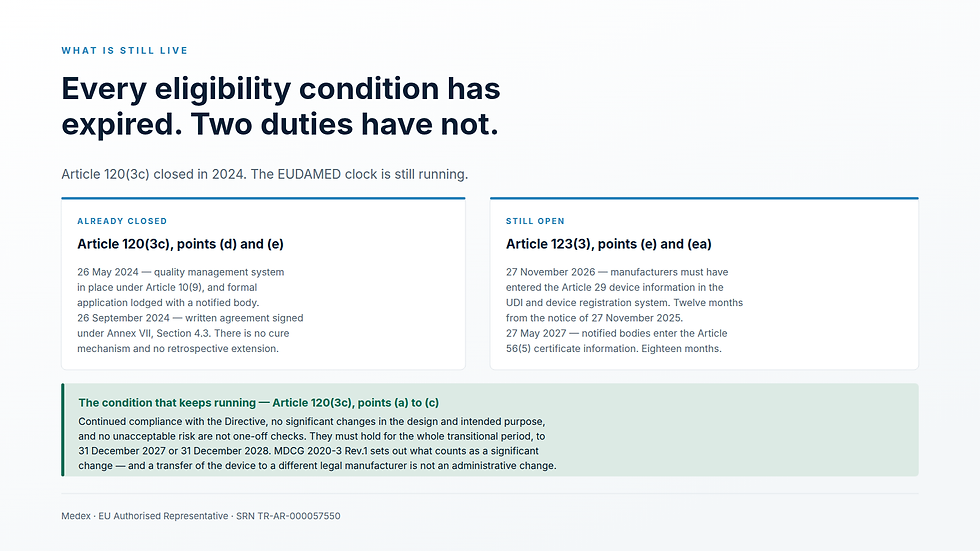
Article 120(3c) lists five conditions, points (a) to (e). The application deadline and the written-agreement deadline both sit inside point (e), which is why the list is often miscounted as six. Point (d) required the manufacturer to have put a quality management system in place in accordance with Article 10(9) no later than 26 May 2024. Point (e) required the manufacturer or the authorised representative to have lodged a formal application with a notified body under Annex VII, Section 4.3, first subparagraph, no later than 26 May 2024, and the notified body and the manufacturer to have signed a written agreement under the second subparagraph no later than 26 September 2024.
All three dates have passed. If any of them was missed, the device lost the benefit of Article 120(3a) or (3b) at that point. There is no cure mechanism, no retrospective extension and no amending act since 2023/607 that reopens them. The MDR transition period is simply over for that device. The remaining routes are full MDR conformity assessment, or a national derogation under Article 59(1) granted device by device by a Member State competent authority in the interest of public health or patient safety, which the Commission may extend Union-wide under Article 59(3).
Points (a) to (c) are different in kind. Continued compliance with the Directive, no significant changes in the design and intended purpose, and no unacceptable risk are continuing conditions that must hold for the whole period, to 31 December 2027 or 31 December 2028. MDCG 2020-3 Rev.1 sets out what counts as significant through a routing chart and five sub-charts covering intended purpose, design, software, materials and sterilisation. Its most consequential passage for a third-country group is what it treats as administrative: a change of manufacturer name, address or legal form, a change of authorised representative, a relocation or addition of a manufacturing site, and a supplier change within specification are all outside “design or intended purpose”. A transfer of the device to a different legal manufacturer is not — and corporate restructuring that changes the legal manufacturer on the label takes the device out of the transitional regime.
Up-classified devices: why Article 120(3b) is not Article 120(3a)
Article 120(3b) covers devices for which the conformity assessment procedure under Directive 93/42/EEC did not require the involvement of a notified body, for which the declaration of conformity was drawn up prior to 26 May 2021, and for which the MDR requires notified body involvement. Those devices may be placed on the market or put into service until 31 December 2028.
This is the self-certified class I device that up-classifies under the MDR — very often standalone software caught by Rule 11. It is a common error to cite Article 120(3a) for such a device. 120(2) and 120(3a) are both predicated on “a certificate that was issued in accordance with Directive 90/385/EEC or Directive 93/42/EEC”, and an up-classified device has no such certificate. The gateway fact is the declaration of conformity drawn up before 26 May 2021; a device first self-certified on or after that date has never had transitional cover at all.
The asymmetry is real and it works in the manufacturer’s favour. A device that up-classifies to class III or class IIb implantable under the MDR still takes 31 December 2028 under 120(3b) — it does not fall into the earlier 2027 bucket, because 120(3a)(a) is confined to certificate-holding devices. Conversely, a device that was certified under the Directive and down-classifies under the MDR takes the date corresponding to its MDR class. Article 120(3c) applies to 3b devices in full, so the 26 May 2024 and 26 September 2024 deadlines applied to them too.
What still applies during the MDR transition period
Article 120(3d) is the overlay. The MDR requirements relating to post-market surveillance, market surveillance, vigilance, and registration of economic operators and of devices apply to 3a and 3b devices in place of the corresponding requirements in the Directives. Everything else — the essential requirements, the technical documentation, the classification, the conformity assessment and the labelling — remains governed by the Directive. MDCG 2021-25 Rev.1 of October 2024 maps this article by article, and confirms that legacy devices are not subject to the MDR UDI requirements, being registered instead with a EUDAMED DI and a EUDAMED ID under MDCG 2019-5.
The registration limb is now live. Commission Decision (EU) 2025/2371 of 26 November 2025, published in the Official Journal on 27 November 2025, confirmed the functionality of the actor registration, UDI and device registration, notified body and certificate, and market surveillance systems. Under Article 123(3), point (d), as amended by Regulation (EU) 2024/1860, those four modules became mandatory six months later, on 28 May 2026. Two derived deadlines are still running: under Article 123(3), point (e), manufacturers must have entered the Article 29 device information within twelve months of that notice — 27 November 2026 — and under point (ea), notified bodies must enter the Article 56(5) certificate information within eighteen months, by 27 May 2027.
Two further duties are easy to overlook. Article 10a, inserted by Regulation (EU) 2024/1860 and applicable since 10 January 2025, requires a manufacturer anticipating an interruption or discontinuation of supply that could foreseeably cause serious harm to inform the competent authority of the Member State where it or its representative is established, and the operators, health institutions and healthcare professionals it directly supplies, at least six months in advance except in exceptional circumstances; the new Article 120(13) extends that duty to 3a and 3b devices. And a non-EU manufacturer of a legacy device needs an authorised representative — MDCG 2021-25 Rev.1 confirms the requirement stems from the Directives and that Article 11(1) MDR applies, with no transitional grace. We are not a law firm and do not provide legal advice.
Sources
Regulation (EU) 2017/745, Articles 10a, 11(1), 59, 97, 120 and 123(3)
Regulation (EU) 2023/607 of 15 March 2023 amending Regulations (EU) 2017/745 and (EU) 2017/746 as regards the transitional provisions for certain medical devices and in vitro diagnostic medical devices, OJ L 80, 20 March 2023, p. 24
Regulation (EU) 2024/1860 of 13 June 2024 as regards a gradual roll-out of Eudamed, the obligation to inform in case of interruption or discontinuation of supply, and transitional provisions for certain in vitro diagnostic medical devices, OJ L, 2024/1860, 9 July 2024
Commission Decision (EU) 2025/2371 of 26 November 2025, OJ L, 2025/2371, 27 November 2025
MDCG 2021-25 Rev.1 — Application of MDR requirements to legacy devices and to devices placed on the market prior to 26 May 2021, October 2024; MDCG 2020-3 Rev.1 — Guidance on significant changes regarding the transitional provision under Article 120 of the MDR, May 2023; MDCG 2022-18 and its Addendum 1, December 2022 and June 2023; MDCG 2019-5 — Registration of legacy devices in EUDAMED, April 2019
Who wrote this
Medex is an authorised representative established in Ankara and registered in EUDAMED under SRN TR-AR-000057550. We are not a law firm and do not provide legal advice. Send us your device list with the certificate details and the MDR class of each device, and we will respond in writing.
A legacy device on the Union market still needs an EU authorised representative where the manufacturer is established outside the Union, and the Article 29 device information still has to reach EUDAMED. Medex files both.


Comments